Showing posts with label fashion. Show all posts

Monday, April 6, 2020

ToDo/NewDo: Ethnic, Up-cycle, and Surface Design with Anna Walden

Getting It Done! Completing Projects

Anna Walden, Point Loma, California

Anna has been completing projects. Here are a few recent ones.


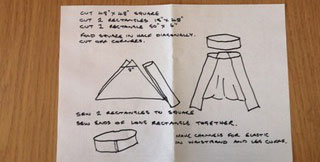
First is a pair of Harem Pants made in plaid cotton flannel according to the instructions in the diagram.  I made them smaller because my fabric was narrower but it turned out to be a good decision as they would have been too large on me.


Second is the Sweatshirt Dress, a up-cycle project. I cropped the sweatshirt, added a skirt in a Liberty knit borrowed from a dress pattern, made the collar from the leftovers, again borrowed.  I drafted the sleeves in Garment Designer and appliquéd the lace using HeatBond and sewing machine.  


The top below is from the Garment Designer pattern I made for the Kuba top project I made this past Fall in a Textile Design class at Mesa College in San Diego. When I made that project, I incorporated fabric that I had dyed using an Ice Dye method. When cleaning up recently,I found the extra fabric, and I sewed it up.  I love this top.  


 A Little About Anna
Anna is a Psychologist and an active textile artist. Most of her creative time is spent sewing or knitting, and ow she has thrown in various forms of surface design. She has published numerous knitting patterns and was part-owner of a yarn company in years past.


Wednesday, February 26, 2020

Fashion and Food Tours in Northern Italy: Italy Anyone?


Italy Anyone?

For the past 15 years, I’ve travelled to Verona, Italy each summer. I first went there in 2006, primarily because I had found out they had an open- air opera that took place in a Roman arena.
So, off I went on my adventure, and I enjoyed not only the opera, but also the city itself.
Verona is a small city, situated in the north. It has a very strategic position in history, as it is between Milan (west) and Venice (east). Most trains from the north come down to Italy through Verona as well.
Enjoying gelato in Verona

 
After my first year, I decided to study Italian, and then, I consciously decided to make friends (which is a bit of a push, even for me, as I have a shy side). All this has blossomed into many wonderful adventures and friendships. And, as always, I was always on the lookout for anything to do with fashion and cuisine.  I feel like serendipity follows me around. Who was to know that..
·      My landlord who was a banker, had a client who owns a knitting manufacturing mill
·      I would strike up a conversation with a small group at the next table in a restaurant, only to find out that he was a food tour guide
·      One of my girlfriends had a friend who was restructuring her grandmother’s home in central Verona into tourist apartments
·      The wife of a restaurant owner was a felter who gives workshops
·      My growing network of friends would watch out for textile/fashion/food things for me
·      Milan and Venice each are just over an hour train ride from Verona and trains run often
·      The ‘nonna’ (grandmother) of the knitting manufacturer’s family enjoys teaching pasta making and cooking to me and my friends
·      The gelateria owner would be willing to let us taste gelato in the realm of wine tasting
·      There is an amazing fashion museum in the country in the middle of nowhere; it was once the summer estate of a lord.
·      Verona is very fashion forward; store windows change constantly and are full of innovative design
·      And so on..

A few years in, I felt I had enough connections to lead small group tours of my second home, Verona. I first organized Fashion retreats and involve artisans, travel to Venice/Milan, and related. People are always gracious to us, and we have some of the most amazing experiences.

Below are some images
 
The Roman wall that touches our apartment building

Store window in Verona

Day trip to Venice

Visits to Jenny Klaer, a yarn store in Verona

A typical vineyard in Valpolicello region

Watching a purse making demo at Dolce and Gabbana in Milan

The sales woman modeling for us at Issey Miyake in Milan

More Issey Miyake fashion, Milan

Nonna... making pasta


This year, I’m hosting two retreats in the month of June. One for food (it’s great for couples), followed by one for fashion.  Information can be found at the links below.


Monday, February 6, 2017

Fashion and Food Trip, Cochenille Design Studio in Italy, June 2017

Need some incentive to come join us in Italy?

June 14th - 23rd, 2017

Verona, Italy, with visits to Milan and Venice.


Come join us this June in Verona for our Food and Fashion retreat.

How about yarn shopping for Italian yarns?


Or maybe some fantastic food, cooked just for you


Then, there are the fashions ... oh how we love Italian style. In museums...


and in the store windows.


We'll visit a weaving establishment in Venice where they weave velvet on traditional hand looms using jacquard punch cards. Customers include Dolce and Gabana, the Kremlin, etc.

bobbins... for color inlay.


And, maybe a cooking class with a chef, in the kitchen of his restaurant.

More temptations to come.  Details can be found at

http://www.cochenille.com/events/category/retreats-workshops/

Tuesday, January 3, 2017

2016 Non-Traditional Christmas Tree


Petticoats hanging on display in LA Garment District
I'm a bit behind this season, and am long overdue with blogging.
But, annual tradition of the non-traditional Christmas tree continues. This year, the theme was somewhat Mexican.

Throughout the year, I'm scouting for a 'theme'. This year, the theme was found on a trip up to the Los Angeles Garment District in November. A group of women, who were here for the Fall Cochenille Design Retreat joined in on a day exploring fabric, fashion, and related in LA.

While walking the streets and browsing fabrics, I happened to notice this great storefront.. with hooped petticoats hanging from the ceiling... so that was 'it'.


Students and faculty from Mesa College assisted in putting the tree together.. and as you can see, we continued with the Mexican flavor.


Lights were placed on my metal frame,
and the hooped skirt was positioned above.
Dressing the head! Notice the eyelashes!

Testing the head
Hanging banners for the skirt
Almost-finished dress


 See the video above and forgive the group singing.


Sunday, October 11, 2015

Visiting the Kyoto Costume Institute, Kyoto, Japan

Anyone who is seriously interested in Fashion History probably owns the book called Fashion. (ISBN3-8228-1206-4)  Within the book are photographs and details about costumes from the 18th to 20th centuries, as found in the Kyoto Costume Institute. Here is an image of the different covers you may find. Note: Sometimes the book is in two parts.

Various versions of the book Fashion by Taschen

While in Kyoto, I was fortunate to be able to visit the Kyoto Costume Institute and spend an hour looking at several pieces in the archives of the collection. The Institute’s corporate sponsor is WACOAL CORP., a clothing manufacturer who specialized in underclothing.

The Kyoto Costume Institute is not really a museum, although they do host exhibits at their location at times. More so, they are an Institute, whose role it is, to collect and document fashion costume from all parts of the world and through time. They work with various museums around the world (e.g. the Metropolitan, Seattle Art Museum), loaning, and coordinating exhibits. If you saw the Future Beauty: 30 Years of Japanese Fashion at the Seattle Art Museum (or other venue), then you were looking at many items from the Kyoto Institute.

Prior to my visit, I had communicated with one of a curator, Rie Nii, and discussed my interest to see unique fabrics in costume, used through history. As a result, the staff had selected about 10 garments for me to see.  Photographs were not allowed, and so, I will direct you to the visuals of some of the garments through online links. There are about 200 items in the online archive, and they are organized by silhouette. Enjoy the entire collection.

Online Digital Archives

Make sure you use the magnifying feature to see closeups of each garment!


The book, Fashion, is available in a few formats (single or double volume), and the covers vary. 
As I walk you through the various garments I saw, I will refer to the page number in the single volume Taschen book.

Page 17
Probably the most exciting item I was able to see was a bodice owned by Queen Elizabeth I (1533-1603). This is the oldest piece in the collection, and sadly, it isn’t in the online digital archive, so hopefully you have the book.  The bodice was probably given to the Queen by the mother of Robert Devereux, in hopes of gaining a pardon for her son. The bodice did not serve its purpose, however and Devereux was beheaded. This piece is made of a plain-weave linen and then heavily embroidered with metal and silk threads using plant and floral motifs.

Page 69

Let’s look now at a dress know as a “robe à la française". This one dates to the late 18th century.
This dress is made of a silk brocade, woven in Lyon, France (the silk capital of France). It has a matching petticoat and stomacher, and is heavily embellished with passementerie (elaborate decorative trimmings).


Page 226

This garment called a visite was popular in the late 1800’s. It is essentially a cashmere shawl (whose popularity started with Napoleon’s Josephine) that has been sewn into a coat (as was the practice in the late 18th century). Zoom into this one, so that you can see the amazing imagery woven into the cloth. The fabric was woven in Lyon, France.


Pages 260-261
Next, we have a Charles Frederick Worth Dinner Dress, c. 1883.

Worth is considered to be the first couturier. This gown, is made of a deep red silk velvet. The pile of the velvet appears in stripe and leaves (make sure you zoom into the image to see this detail). A bustle would be worn under this gown, in order to give the silhouette you see.


Pages 342-343

If you like crochet, you will love this Italian dress made from Irish cotton. Crocheted motifs of flowers and dragonflies are everywhere throughout the gown. I can’t imagine how long it took to make this.


Pages 442-443

Now, let’s look at a cape by French fashion designer Paul Poiret, 1925. The textile design was by an artist Raoul Dufy. Poiret often collaborated with artists to bring art and fashion together. The cut of the cape itself is simple, basically a rectangle, but the design of the cloth (an orange lamé jacquard) with the print on top is what becomes the focal interest.

Page 482

Elsa Schiaparreli was an Italian designer, who incorporated elements of current art movements into her designs. This evening cape from 1938 is made of black velvet and is heavily embellished with gold thread embroider, sequins and beads. The image is of the Greek God Apollo.


I am very grateful to the curators who took the time out of their busy day to allow me to view first-hand garments I’ve discussed in my Fashion History lectures. Looking at them was such a fantastic experience.


The Kyoto Costume Institute
Kyoto, Japan