Showing posts with label Textile Arts. Show all posts

Monday, April 6, 2020

ToDo/NewDo: Ethnic, Up-cycle, and Surface Design with Anna Walden

Getting It Done! Completing Projects

Anna Walden, Point Loma, California

Anna has been completing projects. Here are a few recent ones.


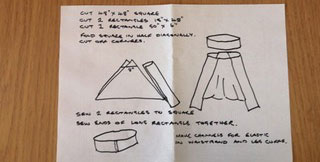
First is a pair of Harem Pants made in plaid cotton flannel according to the instructions in the diagram.  I made them smaller because my fabric was narrower but it turned out to be a good decision as they would have been too large on me.


Second is the Sweatshirt Dress, a up-cycle project. I cropped the sweatshirt, added a skirt in a Liberty knit borrowed from a dress pattern, made the collar from the leftovers, again borrowed.  I drafted the sleeves in Garment Designer and appliquéd the lace using HeatBond and sewing machine.  


The top below is from the Garment Designer pattern I made for the Kuba top project I made this past Fall in a Textile Design class at Mesa College in San Diego. When I made that project, I incorporated fabric that I had dyed using an Ice Dye method. When cleaning up recently,I found the extra fabric, and I sewed it up.  I love this top.  


 A Little About Anna
Anna is a Psychologist and an active textile artist. Most of her creative time is spent sewing or knitting, and ow she has thrown in various forms of surface design. She has published numerous knitting patterns and was part-owner of a yarn company in years past.


Friday, March 20, 2020

Creativity vs. Corona Virus: Get Involved


As many of you know, I own and run Cochenille Design Studio, a company that develops software and design aids for the textile design world. I am a practitioner of many creative arts ranging from sewing, knitting, pattern making, cooking, mosaic, beading, photography, art, and many other things. Having grown up on a farm in rural Ontario, Canada with a mother and grandmothers who were creators gave a sound education in the home and creative arts. Having trained for and taught as a Professor of Fashion for most of my professional career also further nurtured things along.

Today in this world, we definitely live in uncertain times. For my business, we have had two trade shows canceled, which is no surprise given travel and other restrictions. We have also canceled our Italy retreats this June, and are still pending the decision for the France retreat (although I think that has now been taken out of our hands).

Here, at Cochenille, we’ve decided to try and make the best of our new daily life by using our at-home time to be creative. It is after all, National Crafts month.

So, we are asking our Cochenille audience and readers of this blog to join in and share with us on this creative challenge.

We are calling this challenge –ToDo/NewDo
  • The To Do portion is to finish a project that is sitting in your ‘need to do’ pile. This could be a partially-complete project, alterations, or similar
  • The New Do portion is to create a new project using any craft technique, from scratch.
Here is a link to a page on our website, where you can download this ToDo/NewDo list to use.

Join us in this creative solidarity. We hope to make it global. Send me (Susan) a photo of your project along with your info, and a brief description of the project.

I will share and post these for others to see. These do not need to be Garment Designer or Stitch Painter projects. Just jump in and finish up those UFO’s (unfinished objects), or start something new from scratch! In fact, your projects could be things like organizing your sewing room, yarn stash, or other.  Your project doesn't have to be fiber arts; it could be woodworking, home arts, a new recipe, etc. The idea is to use our time creatively and to share with each other.

We will be using this blog as the hosting site. This morning I posted a To Do.... now complete. Check it out.
So, I say Tag!! your turn

I will will post the images sent by those of you willing to be involved on this same blog. Please send them to susan@cochenille.com

Feel free to join the mail list of the blog so you can be notified when an entry is posted. Also feel free to invite friends to join in the ToDo/NewDo Challenge.

Be safe, and be well.

Our very best to all our audience.
Susan Lazear
Cochenille Design Studio

Saturday, March 25, 2017

Fiber, Felt and Inspiration at the Museum of Craft and Design, San Francisco

Recently I seen a few hours viewing an exhibit at the Museum of Craft and Design in San Francisco. I specifically went there to view an exhibit called Felt Decoded, featuring artist Janice Arnold.

As an instructor of Textiles at San Diego Mesa College's Fashion Program, I'm always interested to learn more about fiber and anything related to that. I had heard of this exhibit through an Italian filter friend, Lisbeth Wahl. Small world, that an Italian had to clue me in to an exhibit in my own state, from many miles away.


Here are a few images that were 'wow' moments.


In one area of the exhibit, there is this amazing microscope that you could place over a sample fiber in a container. I have no idea what the level of magnification was, but it as a LOT. Below check out a few fibers (on the left) and their close-up versions (on the right).
Houndstooth

Merino Knit

Denim

Tussah Silk

Lyocell

Felted sample


Tuesday, March 29, 2016

Beauty in Chaos... Textile Art in Christchurch, New Zealand

Currently, I'm visiting Christchurch, New Zealand. My friend Betty, a native of Christchurch has been taking me around, and it is a surreal experience to see the devastation of a city I've visited on several occasions before. The earthquakes of 2011 have completely changed the face of the city, and reconstruction work continues.

Amidst all the chaos that still exists in the city is the Transitional Cathedral, designed by Shiguru Ban. Here is the outside, and a few shots of the inside.


What you are seeing is cardboard tubes, and laminated wood, amongst other things.

The alter was decorated in the most beautiful textile art; a quilted fabric rich in color.
Here are a few shots:


As in all things, beauty exists, and fiber arts play a role.


Tuesday, October 6, 2015

Indigo Dyeing with Hirojuki Shindo in Japan

Two trains and two buses. That is what it took for us to get to the magical village of Kita in Miyama, which lies 60 km north of Kyoto, Japan.


The goal; to visit the Little Indigo Museum, and meet Hiroyuki Shindo, a master of Indigo dyeing. He is known in the fiber arts community and has shown his art indigo pieces in numerous major museums throughout the world.


Shindo-san and his family live in Kita, a village composed of amazing thatched-roof dwellings, many of which are more than 200 years old. The Little Indigo Museum’s dwelling is the oldest, and functions not only as a museum, but a workspace, and living quarters.
A typical house in the village of Kita
The Shindo family was most gracious. The museum, in the upstairs of the home held many examples of indigo fabrics, demonstrating dyeing and printing techniques from around the world.
A view of part of the Indigo Exhibit

A fringed indigo veil worn by a Berber bride in Tunisa 
18th century Indigo print, France

Shindo-san cutting hemp for our projects
The workshop part of our visit allowed us to experience indigo dyeing first-hand. Shindo-san provided each of us with a meter of vintage hemp, and discussed various techniques we could apply using a clamp-resist process. 


The first step was to fold the fabric vertically, so as to expose as much of it as possible in the dye bath. Then, we sandwiched the fabric between wood pieces and clamped them in place.
Folding the fabric vertically
Off to the dye vats!

Indigo Plants
Dried Indigo

Indigo, as a dye substance, is processed from the leaves of the indigo plant.
Here you can see the plants, and leaves once dried, that will be pulverized for use. I was intrigued to learn that a healthy dye bath will be capped with a crowing ‘flower’ formed through a vigorous stirring process, which signifies a healthy ph value.
Stirring to create the 'flower'
The 'flower'
Don and I decided to use two different techniques. I dipped my cloth completely, and Don space-dyed his, meaning he kept part of his cloth from immersing in the fabric.


The amazing thing about indigo dyeing, is that the bath is a yellowish-green. One doesn’t start to see the blue/navy until oxidation takes place. This can happen through exposure to the air, or through the oxygen in water.
 Here you can see my fabric as I have unclamped the wood.


Here are our finished pieces; This was too much fun!
Don's space-dyed piece (left) and my complete immersed piece (right)
This visit was one of the highlights of my Japan trip. I cannot thank the Shindo family enough for their generosity in sharing and in spirit.

To learn more about Hirojuki Shindo and his Little Indigo Museum, click on the link below:

Monday, September 28, 2015

Shibori Technique #2

Technique Two: Fold, Clamp, and Dye
The second workshop I took at the Kyoto Shibori Museum involved techniques of folding, clamping, and dyeing. Again, this is a resist-type of dyeing. The folding of the fabric allows for a repeat pattern to emerge in the final piece. Clamping wooden shapes onto the folded cloth prevents the dye from penetrating the areas underneath the wood. One needs to use wood  pieces(as opposed to plastic, etc.
Samples of Fold, Clamp, and Dye
), as the wood will expand a little when wet, which makes it press even tighter to the cloth.

We began the workshop by looking at samples of finished scarves. Ryo-san pointed out that the shape on the label of each sample indicated the wooden shape used, and it was obvious to see the two colors of dye that would become the base.

Two methods of folding were introduced: a back and forth linear fan-fold, and a triangular type of fan-fold. It is important to have as much surface area of the fabric exposed for dyeing, and this is why a fan-fold (or accordion fold) is used.
 
Beginning to fold the scarf
Once the scarf is folded, you then choose the shapes you want to employ and clamp them down tightly onto the cloth. You need two of each shape, and you sandwich the cloth between the pieces of wood.

Clamps and Wood Shapes
Sandwiching the folded silk between two wood shapes
Another view of clamping
Once all is clamped in place, it is off to the dye bath for the first color. We soaked the fabric in cold water first and then moved it to the hot dye bath. Once we had the depth of color we wanted, then we rinsed the fabric (while still clamped), and then back at the work station, carefully removed the clamps. Without unfolding the cloth, we then sandwiched and clamped down a second set of wooden shapes. I could see that the more one does this, the easier it is to understand what shapes will produce what repeat.

Prepping for the second set of dyeing


Back to the dye room, for the second color. In my case, I used blue in the first dyeing session. I then applied orange in the second dyeing, with the result of creating purple when over-dyeing occurred. Here is a list of how colors would occur on the scarf.
  • Blue – from the first dyeing in non-clamped areas.
  • Orange – from the second dyeing in areas that were clamped the first time, but not the second.
  • Purple – in areas where overdyeing of blue over orange occurred.
  • White – in areas which were clamped by shapes of wood, both times, and thus received no dye.


After the second dye bath, but before the grand unfolding
My finished piece
Again, there was this marvelous moment, when you unveiled the finished result.  Ryo-san held one end of the folded (but now unclamped) cloth, and I held the other end. We counted to three and unfolded the piece.  Magic!!


I can see that the more one works with this, the more you can foresee what you will get with different Shibori techniques. So, I intend to practice this more when I get back home, and document my steps and therefore my understanding. I’m hooked!!


127 Shikiamicho, Nakagyo-ku, Kyoto 604-8261, Kyoto Prefecture
+81 75-221-4252

http://shiborijp.wix.com/kyoto-shibori-museum